

Beyond the Script: Rethinking Engagement through Oral Storying
Updated: Jul 13
By Leong Sook Ting
"If you want someone to hear the truth, you should tell them the truth. But if you want someone to LOVE the truth, you should tell them a story."
— Andrew Peterson, "The Power of Storytelling," The Rabbit Room
The Word Made Audible
We sat down with Ren*, who has been part of the Teochew and Tamil Oral Bible Storying projects, to find out more about what these projects entail. She shared about the behind-the-scenes work involved and how stories ultimately deepen audiences’ understanding of God and point them to Christ.
Oral Bible Storying has been gaining ground in the last 10 – 20 years. This is related to the recognition of the importance of orality as a means of communication and cultural expression.
The Bible is approximately 60% stories, 20% prophecy, 10% wisdom, songs and poetry, and 10% epistles1. Ren asks, if the scriptures were intended to be transmitted largely orally, should we be forcing people to learn to read and write as the only way to encounter God’s Word, or is there another way of transmitting the message?
If we see the Bible as a metanarrative which tells about God’s plan to bring salvation and restoration, stories are a natural means to convey to us who God is, his character and his works.

Giving Voice
How did Ren get into the Oral Bible Storying projects? She says that it was God’s providential direction that led her to explore this area of storytelling. After sampling different dialect groups, she encountered a church with proficient Teochew speakers that was keen to pick up the project. Consultants from “One Story2” then facilitated the training for all involved in the project.
Ren shares that while One Story has a base story set, the stories used in storying projects are largely determined by the team in charge of the project, who select additional stories based on the themes that resonate better with that community.
Sacred echoes: The Joy and Burden of the Craft
Asked what she enjoys about the work of Oral Bible Storying, Ren shared that it was satisfying to engage deeply with the biblical concepts as part of the crafting of stories. “It is a privilege and joy to be doing ‘Bible study’ with the mother tongue translators (MTTs) [who tend to be believers] as we wrestle with what God is saying in the passage. As the MTTs ask questions and we reflect on correctly expressing the message, their faith deepens.” Ren related an example of how she was able to share more deeply about Jesus casting out demons with a Teochew tester who had been having nightmares that touched on the spiritual. For testers3 who are pre-believers, “it is an opportunity for outreach and the projects open doors and conversations that may otherwise have been closed. I realised that this is what discipleship can look like, and it is very meaningful!”
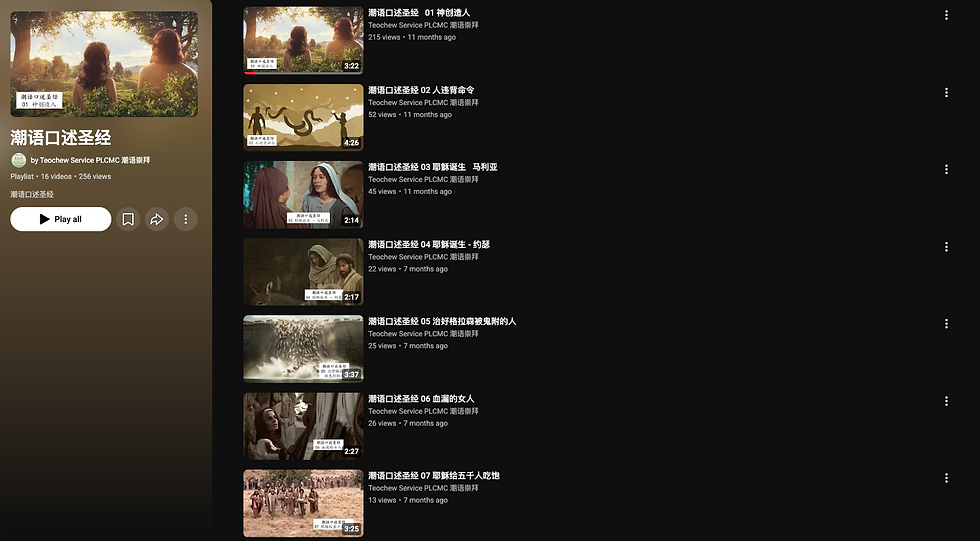
Video playlist on Teochew Oral Storying: In partnership with the Paya Lebar Chinese Methodist Church’s (PLCMC) Teochew Congregation, the Teochew Oral Bible Storying project comprising 16 Bible stories was completed and published online. Try the first video on the Creation story from Genesis 1. Video courtesy of PLCMC’s Teochew Service YouTube site.
Reflecting on the Teochew project, Ren said that the project team realised that as the MTTs were mostly seniors in their 70s, adjustments had to be made – the pace of the work was slower, physical meetings had to be reduced, and various instructions or explanations had to be repeated. The process could feel protracted at times, but they realised that it was a reflection of the deeper, long-term endurance required for the mission as a whole.
As in all Bible translation, Ren said it is challenging to find people willing to work on or support a project where there may not be immediate fruits. A balance also needs to be struck between getting the job done and taking time to develop the MTTs’ skills through hands-on training which is time-consuming. Another challenge is avoiding being a perfectionist while ensuring a good quality translation.
The God who Reaches Down and Lifts Up
Ren reflected on the God who enters our messy world and condescends to reveal Himself in ways we can humanly understand. She asked: “When we do discipleship and outreach, are we expecting people to ‘step up’ to our level, rather than meeting them where they are? God reveals Himself to everyone, regardless of literacy, and He can use anyone. Serving Him is not the exclusive domain of the highly educated.”
In fact, Ren said that one MTT she has worked with only has primary-level formal education, yet possesses a sophisticated mastery of vernacular Bible translation.

New Lenses for Old Stories
Embracing this divine "reaching down" also means reconsidering how we structure the work itself. Some processes may not need to be sequential; for instance, the written Word does not necessarily need to be fully translated before Oral Bible Storying can begin. When asked about potential conflicts, for example, if biblical “key” terms vary between written and oral forms, Ren suggested that the resolution is often administrative rather than theological. After all, terms do get replaced as a translation project (whether written or oral) progresses and better words/phrases are found. This evolution underscores the principle that flexibility is essential for helping people engage with Scripture effectively in their daily lives.
The concept of "storying" as a means for discipling adults can feel counter-intuitive in a Singaporean context, where stories are often perceived as being only for children. It is an assumption Ren believes is worth challenging.
“Think about how Jesus and the Bible communicate truth to us," Ren muses. "Parables are not always easy to comprehend, which in itself challenges the notion that stories are for children. Have we reached a point where we need to re-evaluate our view of cultural narratives?”
This shift in perspective—moving beyond the literal text to the power of the narrative—is precisely what fuelled oral storying efforts. What began as a challenge to our assumptions has now blossomed into a library of living stories.
The Teochew project has now concluded, with 16 Bible stories published on YouTube. You may view them here: Teochew Oral Bible by Teochew Service PLCMC. The Tamil project is ongoing; you can follow their progress and view completed stories at Vaaimoli Bible and follow them at @vaaimolibible.
Missed the beginning?
Revisit this link to explore the foundations of this journey—from establishing a framework for translation to the creative flexibility required to bring Biblical narratives to life.
How to support the work:
Churches could find Oral Bible Storying helpful for discipling and outreach. For resources to train volunteers in the Oral Bible Storying method, email hello@wycliffe.sg.
Other ways to support the Bible translation/ oral storying work include financially, through the R200 (“Reaching 200”) projects. Find out more by emailing r200_projects@wycliffe.sg.
*Ren loves bringing God’s stories to life in daily conversations. She was involved in the Teochew and Tamil Oral Bible Storying projects in Singapore and Malaysia respectively.
Footnotes:
2 The “One Story” method teaches the Bible as a single, interconnected narrative of redemption. It aims to make the Bible accessible to oral learners—people who prefer to learn through listening and speaking rather than reading—by using storytelling, discussion, and memorisation to help people internalise Scripture and pass it on to others.
3 Testers are people whom the stories are told to iteratively to check for understanding, naturalness and accuracy to the Bible text.


Comments